Most people meet Louisiana’s succession law at the worst possible time, holding a set of car keys and a death certificate, trying to work out if the vehicle in the driveway can be transferred without hiring anyone.
The answer turns on a single dollar figure in the Code of Civil Procedure. That figure changed this year, and much of the guidance still in circulation hasn’t caught up.
The number moved from $125,000 to $200,000
Louisiana Code of Civil Procedure Article 3421 defines what qualifies as a small succession, which is the simplified path that avoids a full court-supervised succession proceeding.
For decades, the number crept upward. The 2026 regular session raised it again with Act 293, and the current statute sets the threshold at $200,000 or less for a person who died domiciled in Louisiana.
The previous figure was $125,000. That older number still sits in much published guidance, many professional service pages, and the working memory of plenty of people who deal with this occasionally rather than daily.
The practical consequence is significant. A $160,000 estate was over the line under the old rule and is comfortably under it now. That is the difference between a notarized affidavit and a court proceeding.
The trap: there are two thresholds, and only one changed
Here is the detail that even careful summaries get wrong.
Article 3421 sets out two situations. One covers a person who died domiciled in Louisiana, and that threshold is now $200,000. The other covers an ancillary succession, meaning a person who died domiciled somewhere else but left property in Louisiana.
The ancillary threshold is still $125,000. It was not raised.
So the same estate can qualify or not depending entirely on where the deceased was domiciled at death. A Louisiana resident with a $160,000 estate qualifies. A Texas resident with $160,000 in total property, some of it a vehicle sitting in Louisiana, does not.
Anyone repeating “the threshold is now $200,000” as a flat statement will eventually give somebody the wrong answer.
Gross value, and the date that matters
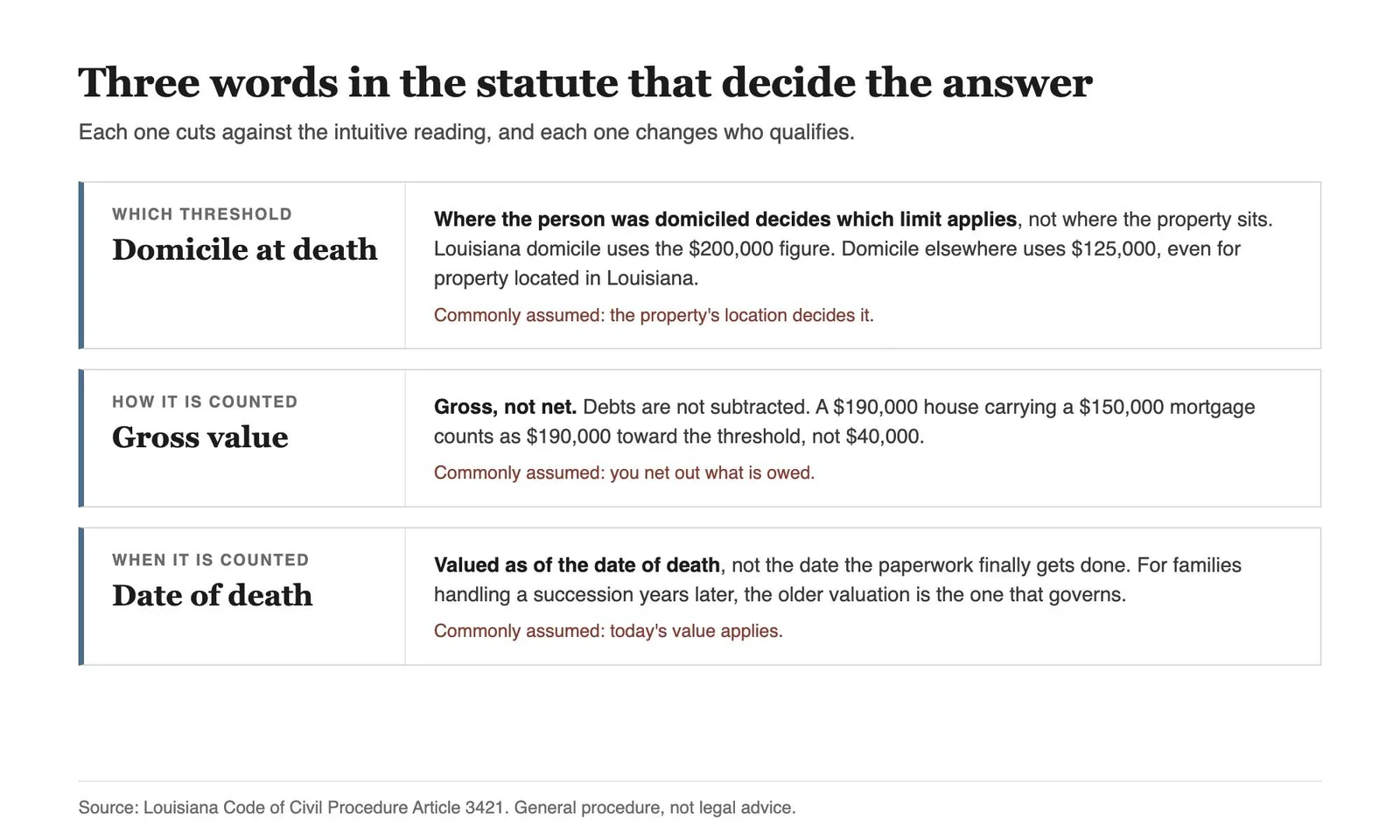
Two more words in the statute do a lot of work, and both run counter to the intuitive reading.
The measure is gross value, not net. It is the value of the property, not what is left after debts are subtracted. An estate with a $190,000 house carrying a $150,000 mortgage has a gross value of $190,000 for this purpose, not $40,000. People routinely net it out and reach the wrong conclusion.
And the valuation date is the date of death, not the date somebody finally gets around to handling it. That cuts both ways. A vehicle is worth less now than it was three years ago when the owner died, and the older, higher figure is the one that counts. Property that has appreciated since is measured at the lower, earlier value.
For a family dealing with a succession years after the fact, which is extremely common, the date-of-death rule is often the thing that decides the outcome.
Why the vehicle is usually the first thing anyone notices
Successions get postponed. Houses can sit, bank accounts can wait, and families put off the paperwork for entirely understandable reasons.
Vehicles do not cooperate with that. Registration expires. Insurance gets complicated when the named insured has died. Someone wants to sell it, or a family member is driving it and would like the title to say so. The car is the asset that forces the issue, which is why the vehicle is so often the first point of contact with succession law rather than the last.
That timing matters because the vehicle question and the estate question are the same. What documents the transfer needs depends on which succession path the estate qualifies for, and that depends on the threshold above. A guide to retitling a vehicle after the owner’s death in Louisiana is more useful read alongside the estate math than after it.
What this does not change
It is worth being clear about the limits, because a raised threshold is not a general invitation to skip professional help.
Qualifying as a small succession simplifies the procedure. It does not resolve a disputed inheritance, an unclear heirship, a blended family with competing claims, or an estate where somebody is likely to contest. The simplified path assumes agreement. Without agreement, the dollar figure is beside the point.
It also does not change what the vehicle transfer itself requires at the counter. The ordinary Louisiana title transfer process still applies once the succession question is settled, with its own document set and its own reasons for getting rejected.
The practical version
If you are working out if an estate qualifies, three checks settle most cases.
Establish where the person was domiciled at death, because that determines which of the two thresholds applies, and the gap between them is $75,000.
Add up the gross value, not the equity, and use the values as of the date of death rather than today’s.
Then check the date of any published guidance you are relying on. A page that says $125,000 for a Louisiana resident describes the law as it was before the 2026 session, and that difference is large enough to change the answer for many ordinary families.
The number is not hard to find. It is just recently different from what most sources still say.
Clint L. Sanchez is the founder of BlakSheep Creative, a Louisiana web design and marketing agency. This article is a sponsored contribution and contains links to a client’s website. It describes general procedure and is not legal advice.